
Forehead Surgery
Shaping the proportion and depth of the forehead,
purely into balance

Shaping the proportion and depth of the forehead,
purely into balance
Changing the forehead means
looking at width and sagging together
Forehead concerns divide into width and sagging, but the answer must always consider both together.
Assessment
Hairline position, forehead curvature and brow droop are not assessed separately but placed on one picture and read together.
Direction
Reading facial proportion and scalp elasticity together, we plan the direction that fits the balance among lift, reduction, or reduction with lift.
Structure
Rather than smoothing the surface alone, the fascia and scalp are drawn and fixed to the skull at several points so they do not slip back.
The scar within the hairline,
the fixation firm
Incisions mostly follow the hairline at an angle matched to the hair direction, keeping hair damage to a minimum.
The lifted tissue is fixed firmly to the skull at several points so it does not slip back, and where an endoscopic approach can be used, the incision and recovery tend to be lighter.
Three methods
to suit the balance of your forehead

Forehead lift

Forehead reduction
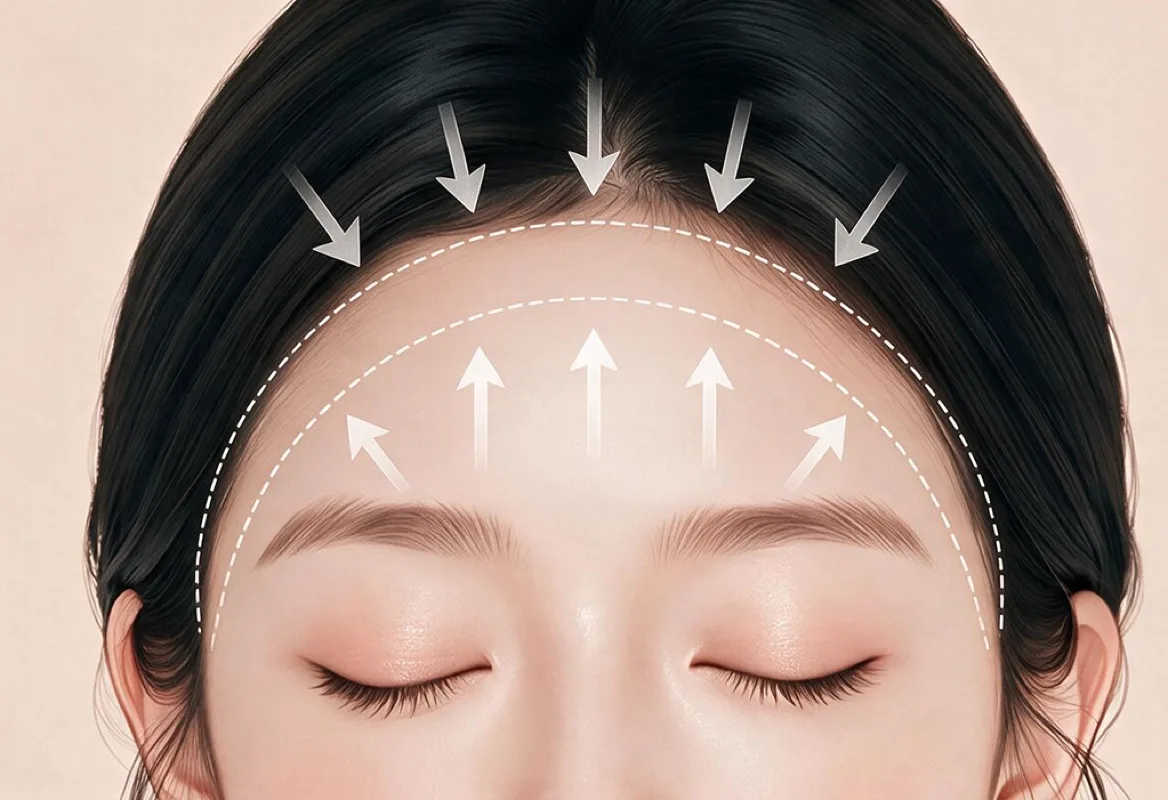
Forehead reduction & lift
The Butler principle
Nerves governing expression and sensation run around the forehead and brows, and with a hairline incision the care taken in reading follicle direction decides the result. The specialist assesses facial proportion, scalp elasticity and the degree of sagging together to plan the method and the amount of lift and reduction, working on the principle of incision and suture that limits follicle damage. From pre-anesthetic assessment through recovery, care is managed stage by stage under safety procedures.
Who it suits
Those with pronounced horizontal forehead and glabellar lines
Those whose drooping brows make the eyes look heavy and sleepy
Those whose broad forehead makes the face look long
Those who want to address a broad forehead and sagging in one surgery
Those wanting structural change rather than Botox or hair transplant
Procedure & device information
About the procedure
Step 1. Consultation and assessment (forehead height, sagging, brow position, scalp elasticity)
Step 2. Choosing the method and designing the hairline, lift and reduction
Step 3. Anesthesia
Step 4. Follicle-sparing incision and forehead and scalp dissection (endoscopic or open)
Step 5. Scalp advancement, forehead tissue lifting and periosteal fixation
Step 6. Suturing along the hair direction and compression dressing
Step 7. Follow-up check and suture removal
Aftercare
- Please do not remove the forehead compression bandage before you are told to.
- Please rest with your head elevated for a few days after surgery.
- Please do not scratch the incision or brush it firmly.
- Please start washing your hair and face only after the medical team's guidance.
- Please avoid alcohol and smoking for at least 2 weeks.
- Heavy exercise and saunas are recommended from about 4 weeks.
- Swelling around the eyes lasts about 1–2 weeks and then gradually subsides.
- Temporary numbness of the scalp usually recovers gradually.
FAQ
How is a forehead lift different from Botox?
Botox temporarily reduces muscle movement to soften lines, whereas a forehead lift raises and fixes the sagging tissue itself, so a more structural and longer-lasting change can be expected.
How much can forehead reduction shorten the forehead?
It depends on scalp elasticity and how far it can be drawn, and varies between individuals. There is a limit to how much can be reduced at once, so we explain the possible range at assessment.
Can reduction and lifting really both be done in one surgery?
Because they share the same hairline incision, forehead reduction and lifting can be done together through one incision and dissection. The possible extent is still set by scalp elasticity.
Will the scar be noticeable?
An angled incision matched to the hair direction keeps hair damage minimal, and because it is designed along the hairline, it tends to be less noticeable once healed.
How long do the results last?
It varies between individuals, but because the tissue is drawn and fixed it is generally known to last several years or more. Aging continues, so we cannot state a fixed duration.